Every few weeks, a post resurfaces claiming ChatGPT is hiding a smarter, forbidden version of itself. Those seeking divine assistance are just one swipe through seven prompts away from Solomon’s wisdom and the Midas touch. It isn’t hidden. No prompt hands you wisdom you don’t have, or turns your typing into gold. What’s actually being asked for is your judgment.
Why this matters to you: If you’ve felt that flicker of “wait, is this real?” scrolling past one of these — trust that instinct. That’s the part of you this post is going to arm.
❌ The Problems This Post Addresses
- The “Secret AI mode” myth, and why no version of ChatGPT has one
- Why urgency language (“save this before you lose it”) is a manipulation tactic, not a feature
- The gap between AI sounding confident and AI actually being right
✅ What You’ll Understand
- Why this exact template — “secret mode,” “God Mode,” “illegal to know” — keeps reappearing across unrelated accounts
- What a prompt can and cannot do for your judgment
- Why outsourcing your decisions, one clever prompt at a time, has a cost you won’t see coming
Your Defense: The Sovereign War maps exactly this pressure — the slow handoff of judgment to a system that sounds smarter than you.
Learn More
There Is No Secret Setting. There’s a Template.
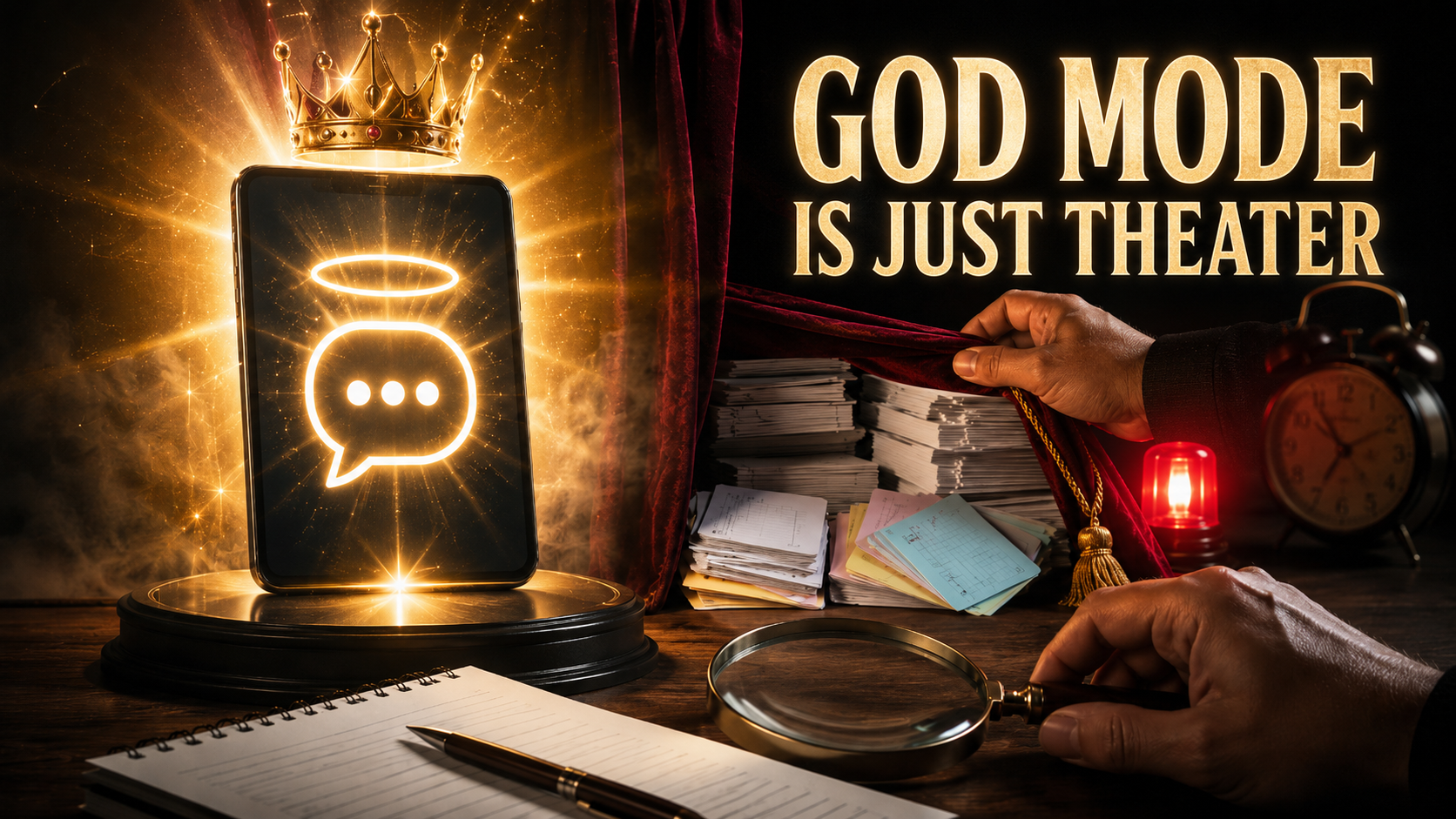
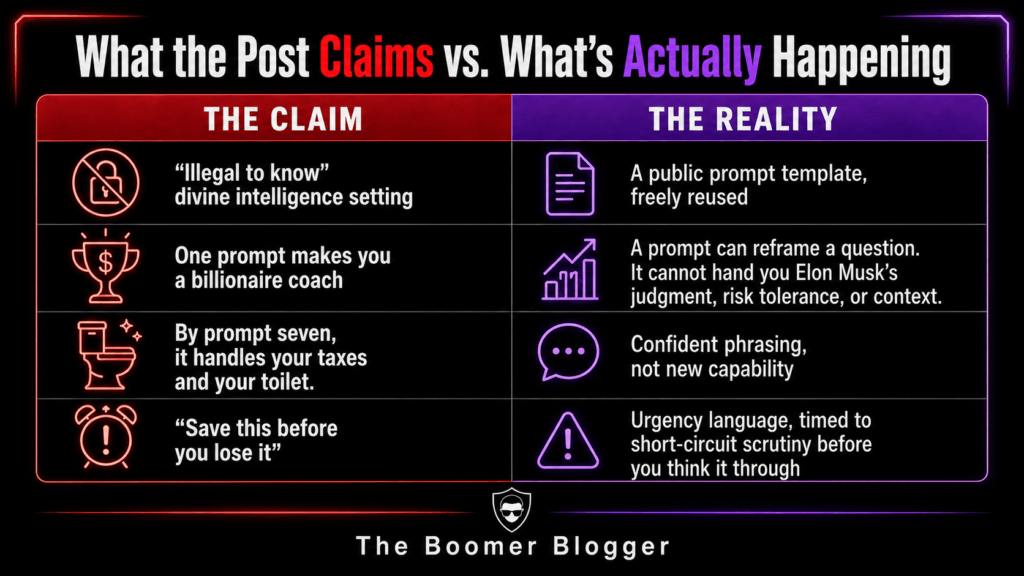
Let’s start where the post starts: “ChatGPT has been hiding a divine intelligence setting from everyone — except those willing to swipe through seven prompts.” No, it hasn’t. There is no hidden tier, no developer toggle Sam Altman is sitting on, no “God Mode” waiting behind a paywall of curiosity. What exists is a content format — a carousel of prompts dressed up as a leak.
The Magnifying Glass: This Exact Wording Is Everywhere
Here’s the part that should bother you more than the original claim. “ChatGPT has a secret mode. It can think like a God. Here are 7 prompts that feel illegal to know” isn’t one creator’s discovery — it’s a script. The nearly identical wording is circulating right now across Threads, Facebook, Instagram, and TikTok, posted by accounts with no connection to each other. That’s not a leak spreading. That’s a template being copy-pasted because it performs.
Nobody found a secret. Somebody found a format that gets shares — and “divine intelligence” tests better than “here’s a decent prompt.”
Prompts Can Sharpen a Question. They Can’t Replace Judgment.
A well-built prompt can genuinely improve what you get back — more context, a clearer ask, a tighter answer. That’s real, and it’s worth learning to do well. What a prompt cannot do is hand you judgment you don’t already have. ChatGPT sounding confident about your tax strategy or your plumbing isn’t the same as ChatGPT being correct about it. Polished nonsense is still nonsense — it’s just nonsense with better sentence structure.
“Think like a god” is a headline, not a capability.
Why “Save This Before You Lose It” Is the Real Tell
Notice what the urgency is doing. It’s not protecting you from missing a good resource — it’s timed to arrive before you’ve had a chance to ask an obvious question: if this worked, why is it free, viral, and unverifiable? Urgency replacing scrutiny is the mechanism, not a side effect. That’s worth remembering the next time a post tells you to act before you think.
The Real Pressure Underneath It
This is where it stops being about one silly prompt carousel. The pattern — hand a decision to something that sounds more confident than you, faster than you’d normally allow yourself to check it — has a name. AlchemMyst calls it the Morrígan pressure: decision muscle atrophy. Every time you outsource a judgment call instead of making it, the muscle for making that call gets a little weaker. Predictable people are steerable people, and a person who’s stopped trusting their own judgment is easy to steer.
You are not broken. You almost fell for a Solomon-and-Midas pitch because you’re human, and humans respond to confidence dressed up as certainty. You are unarmed — nobody ever handed you the map showing how these pressures work, until now. Let’s fix that.
Frequently Asked Questions
Did this one get you scrolling twice? Drop a comment — what’s the most “illegal to know” AI prompt you’ve seen this month?
Does ChatGPT have a secret “God Mode” or divine intelligence setting?
No. There is no hidden tier, toggle, or setting in ChatGPT that unlocks a more powerful or “divine” version of the model. Posts claiming this are reusing a viral content template, not reporting a real feature.
Can a clever prompt actually make AI give me expert-level judgment?
A good prompt can sharpen the question and improve the response’s clarity and relevance. It cannot supply judgment, risk assessment, or expertise you don’t already have — confidence in the AI’s tone isn’t evidence of accuracy.
Why do “secret AI mode” posts keep reappearing across different platforms?
Because they work. Near-identical wording gets reposted by unrelated accounts because the “forbidden knowledge” format reliably drives shares — it’s a proven template, not a genuine discovery being passed along.
Is urgency language like “save this before you lose it” a red flag?
Yes. Genuine, useful information doesn’t usually require artificial time pressure to be worth keeping. That urgency is designed to get you to save and share before you stop to evaluate the claim.
Did this one get you scrolling twice? Drop a comment — what’s the most “illegal to know” AI prompt you’ve seen this month?