By MrDon | BoomerBlogger.com / SettingPoints.com
The Web You Built Your Blog On Doesn’t Exist Anymore
Not metaphorically. Structurally.
I know that’s a hard sentence to read if you’ve spent years building a WordPress presence. If you’ve sweated over keyword research, obsessed over on-page SEO, published three posts a week on a schedule that would make a newspaper editor nod in approval. If you’ve done everything right — the meta descriptions, the internal links, the alt tags on every image — and watched your traffic slide anyway.
It’s not you. The floor moved.
Here’s what the numbers look like right now, in plain language:
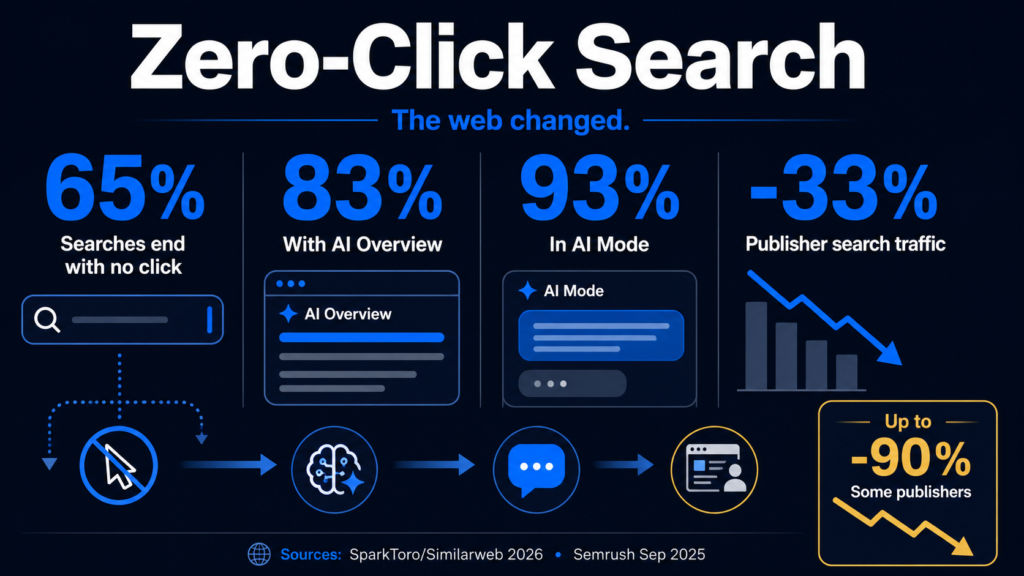
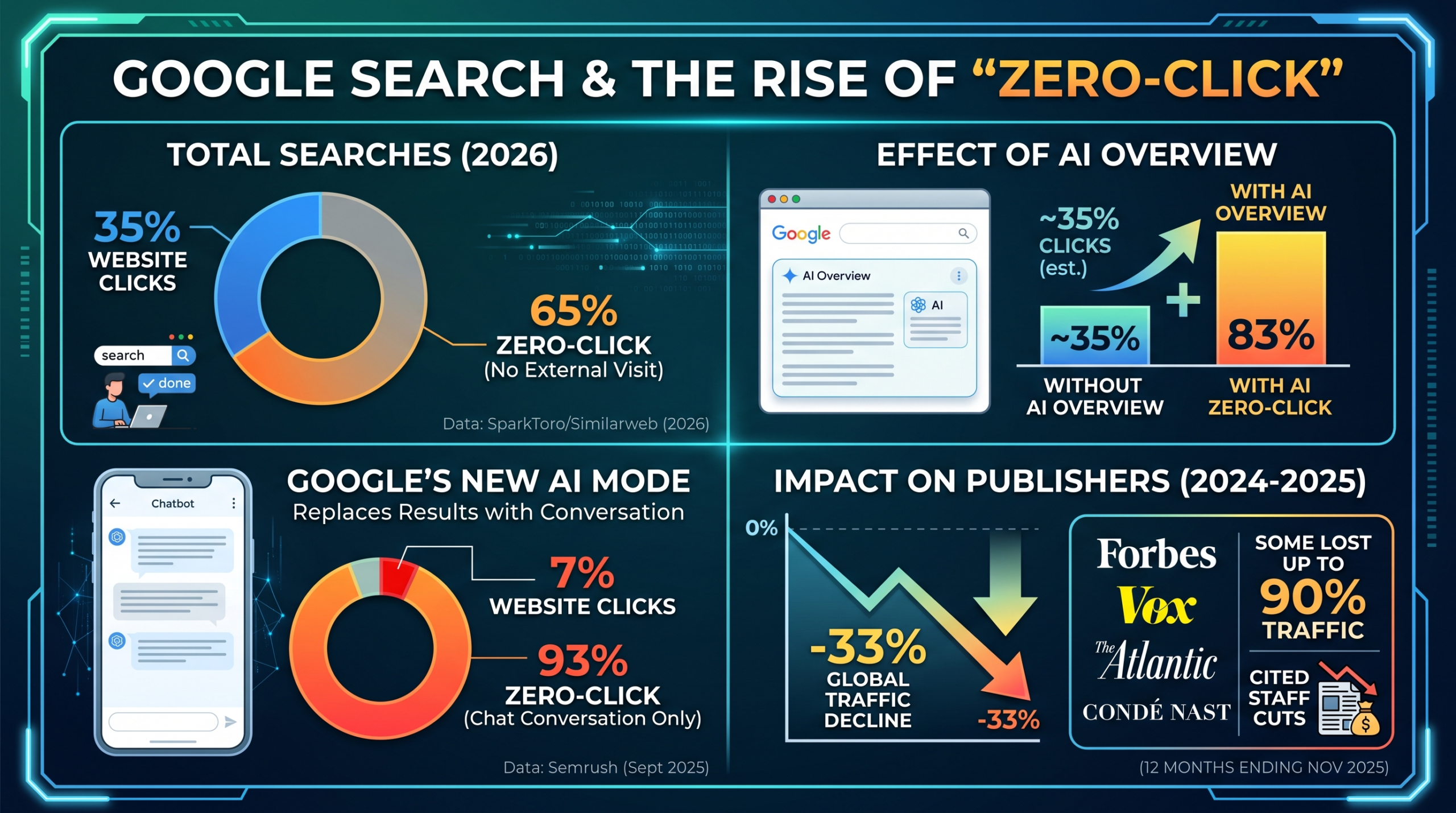
Nearly 65% of all Google searches in 2026 end without a single click to any website. Not your website. Any website. The user typed a question, Google answered it on the page, and left. Done. (SparkToro/Similarweb, 2026)
When Google’s AI Overview feature is active — and it now appears on the majority of informational queries — that zero-click rate jumps to 83%.
Google’s newest product, AI Mode, doesn’t just put an AI summary above the search results. It replaces the search results entirely with a conversation. In AI Mode, 93% of searches end without a click to any external site. (Semrush, September 2025)
Google search traffic to publishers fell 33% globally in the twelve months ending November 2025. Some publishers — the large, established ones with full editorial teams and decades of content — have reported losing up to 90% of their traffic. Forbes. Vox. The Atlantic. Condé Nast cited search-traffic decline as a contributing factor in staff cuts.
And WordPress bloggers are still out here writing “10 Best Tips for [Topic]” posts like it’s 2017.
This piece is about what actually happened, why it happened, and — more importantly — what you do about it. Not the usual “pivot to video” hand-wave. A real architectural answer.
Because there is one.
WordPress Is No Longer the Whole Stack
For twenty years, WordPress was the complete digital presence. You installed it, you wrote, Google found you, readers came, and if you were good at it, money followed. The entire ecosystem — content creation, SEO, discovery, monetization, brand identity — lived inside one platform, one login, one dashboard.
That was never really about WordPress. It was about Google.
WordPress was the engine. Google was the fuel. When the fuel changed, the engine didn’t matter.
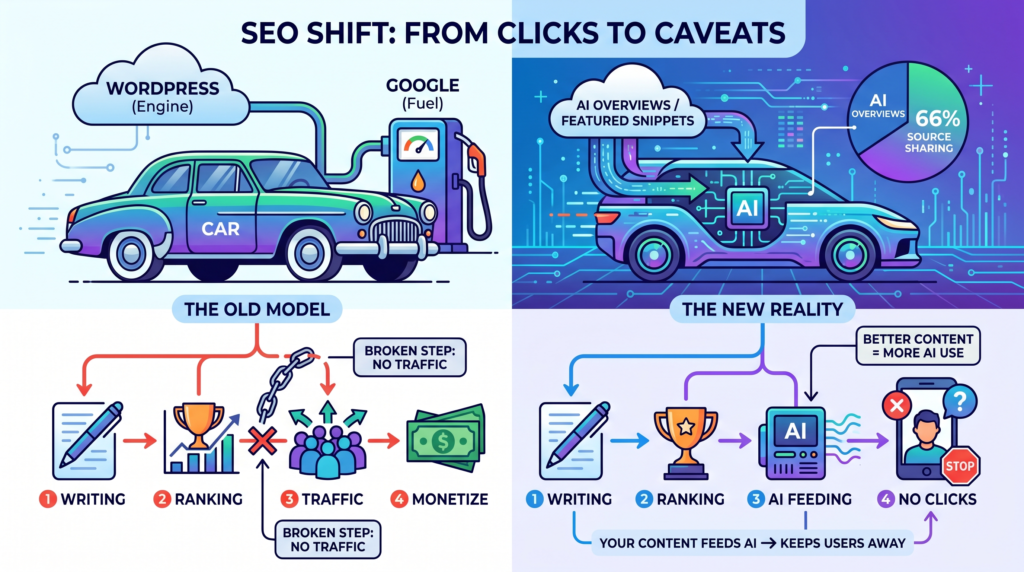
Here’s what actually changed: the model that powered every affiliate blog, every informational website, every ad-revenue publishing operation — write → rank → get traffic → monetize — has broken at the middle step. The writing still works. The ranking still works, technically. Traffic is what stopped coming.
And it stopped coming for a structural reason, not a quality reason.
AI Overviews and featured snippets now share 66% of their source material. That means if you win a featured snippet — the holy grail of the old SEO game — you’re probably feeding the AI Overview that’s replacing your click. The better your content, the more useful it is to the machine that’s keeping people away from it.
That is not a solvable SEO problem. That is a business model problem.
WordPress is not dead. Let’s be clear about that. But it has changed jobs.
Today, WordPress is one layer of a two-layer system. It is no longer the front door to your digital presence. It is the vault behind the front door.
The front door is somewhere else now. Most bloggers haven’t built it yet.
The Two-Layer Model
This is the architecture of the web going forward. Understanding it is the difference between building something that lasts and continuing to feed content into a machine that processes it without paying you.
Layer One: The Authority Layer
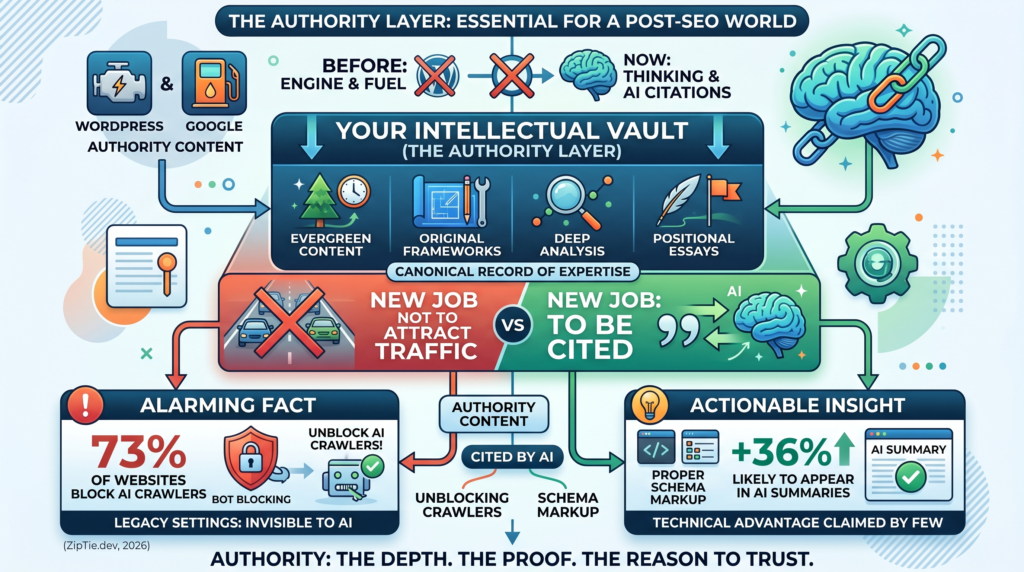
This is WordPress. This is where your thinking lives.
Evergreen long-form content. Original frameworks. Deep analysis. Essays that take a position and defend it. The canonical record of your expertise — the intellectual vault that proves you know what you’re talking about.
Its new job is not to attract traffic. Its new job is to be cited.
In the post-SEO world, AI systems are the first point of contact between a question and an answer. When those systems answer a question, they cite sources. The sources they cite are the ones that appear credible, structured, and readable by their crawlers.
Here is something that should alarm you: 73% of websites are currently blocking AI crawlers. Not intentionally, in most cases — it’s legacy settings from the old bot-blocking era. But if an AI crawler cannot read your site, you do not exist to the AI. Your content is invisible to the system that now mediates between your audience and your expertise. (ZipTie.dev, 2026)
Pages with proper schema markup — structured data that tells crawlers exactly what your content is and means — are 36% more likely to appear in AI summaries. That is a massive technical advantage sitting unclaimed by most bloggers.
The Authority Layer is the depth. The proof. The reason someone who found you through an experience decides to trust you. It’s not the hook. It’s what the hook leads to.
Layer Two: The Interactive Layer
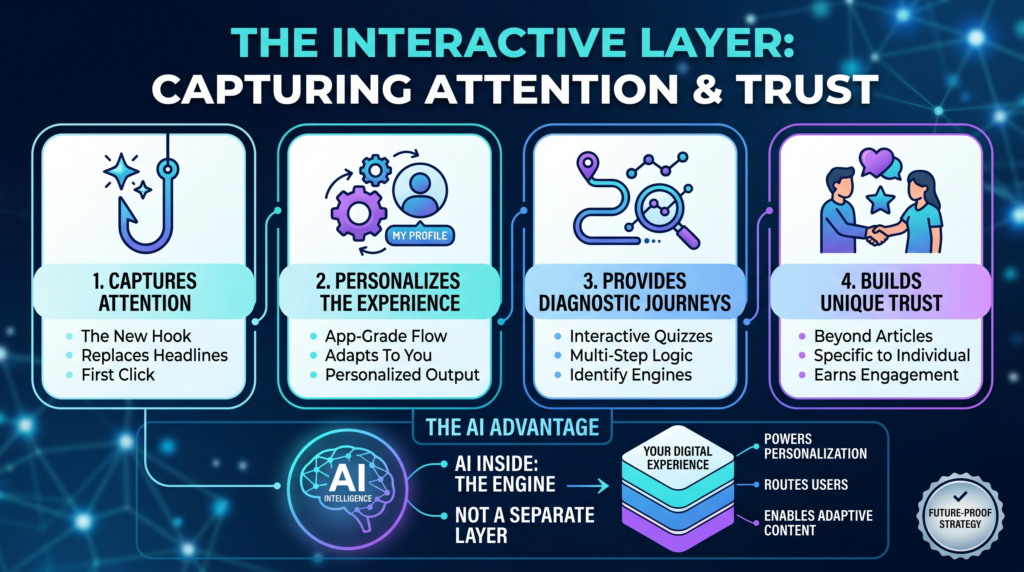
This is the part most WordPress bloggers don’t have. And it’s the part that matters most right now.
The Interactive Layer is an app-grade, dynamic experience that a user moves through — not a page they read. Quizzes. Diagnostic journeys. Identity engines. Calculators. Personalized outputs. Multi-step logic that adapts based on who you are and what you say.
Here is the key question to ask about any piece of content or any digital experience: Can an AI summarize this and give the user what they came for without them ever leaving the search page?
For a blog post explaining “What Is Color Psychology” — yes. An AI can summarize that in two sentences. Zero-click. Gone.
For an interactive diagnostic that asks you 20 questions about how you move through the world and returns a personalized identity profile specific to your answers — no. An AI cannot deliver that on a search results page. There is nothing to summarize. The experience is the product.
This is the gap. This is where the new attention lives.
The Interactive Layer is the new top of funnel. It is the hook that replaces the blog post headline. It earns attention before anyone reads a word of your long-form content — and it creates an experience so specific to the individual that it builds the kind of trust that a library of articles never could.
The key insight to hold: AI is not a third layer in this model. AI is the intelligence inside the interactive layer. It’s the engine that powers personalization, routes users to the right experience, and makes adaptive content possible. You don’t compete with AI. You put AI inside the thing you built.
What AI Can and Cannot Do to Your Blog
Let’s be precise about this, because there’s a lot of fuzzy thinking going around.
Here is what an AI system can do with your blog post, right now, today:
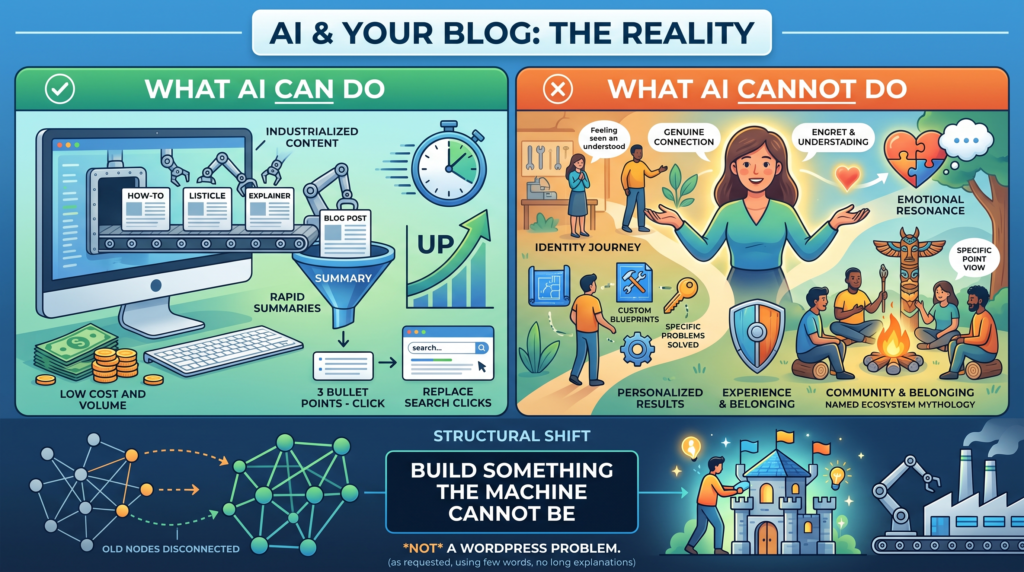
Summarize it. Read the whole thing and distill it to three bullet points. Answer the specific question your post was written to answer. Compress 1,500 words of carefully crafted content into a paragraph that appears above the search results before anyone sees your title. And replace your click.
Every informational post — the how-tos, the listicles, the explainers, the beginner’s guides — is vulnerable to this. Not eventually. Now. The informational blog post, which was the workhorse of the WordPress publishing era, has been industrialized by AI. The machine produces it faster, at higher volume, with no overhead, around the clock. You cannot win that competition by writing more posts.
Here is what an AI system cannot do:
Run a multi-step identity journey that makes a user feel genuinely seen. Deliver a personalized result based on that specific person’s specific inputs. Create the emotional resonance of a tool built specifically for your problem. Build community and belonging around a named ecosystem with a mythology and a point of view. Replace the experience of being understood.
Writing more posts will not fix the traffic problem. Better SEO will not fix the traffic problem. A new theme, a faster host, a different keyword strategy — none of it fixes the traffic problem, because the traffic problem is not a WordPress problem. It’s a structural shift in how the web works.
You can build something the machine cannot be.
That’s the whole game now.
The New Funnel
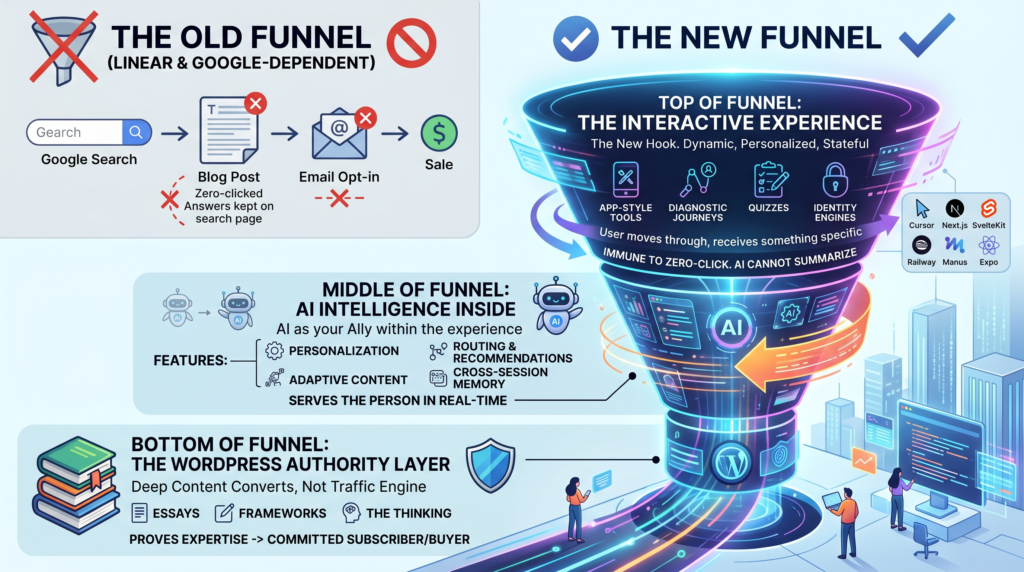
The funnel that powered the WordPress era was linear and Google-dependent:
Google Search → Blog Post → Email Opt-in → Sale
That funnel is broken at the first step. Google search is no longer reliably delivering people to blog posts. It’s delivering them answers — and keeping them on the search page.
The new funnel doesn’t start with Google. It starts with an experience.
Top of Funnel: The Interactive Experience
This is the new hook. An app-style tool, a diagnostic journey, a quiz, an identity engine — something dynamic, personalized, and stateful that a person moves through and receives something specific to themselves on the other side.
This cannot be zero-clicked. There is no answer for Google’s AI to surface because the experience itself generates the answer in real time, based on that user’s inputs. It is immune to summarization.
It’s built with tools designed for software, not publishing: Cursor, Next.js, SvelteKit, Railway, Manus, Expo. More on the specific stack in a moment.
Middle of Funnel: AI Intelligence Inside the Experience
Once someone is inside your interactive experience, AI becomes your ally. Personalization, routing, recommendations based on who this person is and what they’ve told you. Adaptive content that changes based on their identity. Cross-session memory. This is AI doing what it’s genuinely good at — serving the person in front of it, inside a system you designed.
Bottom of Funnel: The WordPress Authority Layer
Here’s where your existing content investment pays off — just differently than you expected.
The person who went through your interactive experience now wants depth. They want the essay. The framework. The thinking behind the tool they just used. Your WordPress vault delivers it. Not as a traffic engine, but as the proof of expertise that converts a curious visitor into a committed subscriber or buyer.
The blog didn’t disappear. It moved to the bottom, where it was always most powerful: as evidence of depth, not as a discovery mechanism.
The Gap Most Bloggers Haven’t Crossed
The gap between the old model and the new one is not technical. You don’t need to become a developer. You don’t need to learn to code from scratch.
The gap is conceptual. It’s a different mental model of what you’re building.
The 2015 model: Content → SEO → Traffic → Revenue
The 2026 model: Experience → Trust → Community → Revenue
The role shift looks like this:
| What You Were | What You’re Becoming |
|---|---|
| Content producer | Experience designer |
| SEO optimizer | AI citation strategist |
| Traffic farmer | Community builder |
| Post scheduler | System architect |
None of those new roles requires you to abandon writing. Writing is still the core skill. But the purpose of the writing has changed. You’re not writing to rank. You’re writing to establish authority that makes everything else credible.
One more data point worth sitting with: AI Overviews reduce total click volume, but the clicks that do survive convert 23% better. (DigitalApplied, 2026) The users who click through after seeing an AI summary are specifically looking for more than the summary provided. They are the highest-intent visitors you’ve ever had. A smaller number of far more qualified people.
That changes what you optimize for. You’re not chasing volume anymore. You’re building the destination that high-intent visitors want to arrive at.
The bloggers who survive this moment are not the ones who wrote the most articles. They are the ones who built something people would actively miss if it disappeared.
Where to Build the Interactive Layer
This is the practical question. You understand the model. Where does the technology actually live?
For Rapid Deployment: Manus + Railway
If you want to build and launch quickly — to prototype a diagnostic journey, an identity engine, or a personalized quiz experience — Manus combined with Railway hosting is the current answer for rapid deployment. It handles AI-driven logic, personalized routing, and multi-step experiences without requiring deep infrastructure expertise.
This is the stack behind the Find Your Chamber diagnostic at AlchemMyst. Twenty questions. Ten possible identity outcomes. Personalized routing to an entire ecosystem. Built and deployed without an engineering team.
Best for: testing a concept, launching a first interactive experience, validating the model before going deeper.
For Permanent Infrastructure: Next.js + Expo + Edge Functions
For experiences built to scale — multi-device deployment, deep personalization, vector search, cross-session memory — the long-term stack is Next.js (web), Expo (mobile), and edge functions for AI inference at speed.
This is app-grade infrastructure. It’s the architecture for the unified intelligence layer when you’re ready to build it.
Best for: anything you intend to be a permanent, scaled experience rather than a prototype.
What Not to Build On
WordPress plugins. Webflow. Wix. Low-code quiz builders like Typeform or Outgrow.
This is not a criticism of those tools. They are excellent publishing and form tools. They are not software platforms. They cannot handle stateful, AI-native personalization. They cannot build the kind of experience that is immune to zero-click displacement. They are Layer One tools. Building your Layer Two on a Layer One platform is the same mistake as building your whole strategy on Google’s goodwill.
You’ve seen how that ends.
What This Looks Like in Practice
This is not theory. Here is the architecture applied across a real ecosystem:
SettingPoints.com — Authority vault. Frameworks, strategic analysis, and long-form essays that establish the intellectual foundation of the ecosystem. The place that credible thinkers point to.
BoomerBlogger.com — The generational voice. Manifesto-grade content written from the specific perspective of a creator who has navigated every major shift the internet has made. The entry point for the Boomer creator audience.
AlchemMyst.com — The mythic authority layer. Ten chamber frameworks, the Morrígan’s Warfare Doctrine, deep dives into the archetypes that name the problems of the AI age. Paired with the Find Your Chamber diagnostic — a 20-question interactive journey that routes visitors into a personalized identity profile and an entire ecosystem built around it.
PowerColorCodex.com — Color psychology as signal intelligence for professional women in high-stakes environments. The WordPress layer holds the frameworks and the positioning. The interactive layer — currently in development — is the color identity engine: a quiz that returns a personalized color profile, operational recommendations, and a direct path to the product.
The Morrígan’s Warfare Doctrine PWA and the Morrígan Moment Android app — already live Layer Two deployments. App-grade experiences built for app stores and direct access. Not waiting for Google.
The two-layer architecture isn’t a future plan. It’s already in motion.
The Boomer Blogger Manifesto for the Post-SEO Era
Alright. The data section is done. Now let me say something true.
We built the original internet.
Not Silicon Valley. Not the venture capitalists. Not the engineers with the whiteboards and the kombucha on tap.
We did. The bloggers. The writers. The people who looked at a blinking cursor on a homepage in the early 2000s and thought — I have something to say, and this thing will let me say it — and hit publish for the first time.
We were the content before “content” became a job title. We were the community before “community management” became a department. We built readership out of nothing, one post at a time, with no algorithm to help us and no playbook to follow.
And we’ve been told we were obsolete before. Repeatedly.
When social media arrived, they said blogging was dead. We adapted. When mobile took over and attention spans shrunk to the length of a tweet, they said long-form was over. We adapted. When content farms flooded the zone with AI-adjacent garbage, they said authentic voices were drowned out. We adapted.
Now they’re saying AI killed the blog.
Fine. We’ve heard that song before.
Here’s what’s actually true: the written word is not dead. It changed jobs.
For twenty years, writing was the front window of your digital presence. The thing that faced the street, caught the light, and pulled people in off the sidewalk. Now the front window belongs to something else — the interactive experience, the diagnostic journey, the identity engine. The thing that reaches out and meets the person where they are.
The writing moved to the foundation. And foundations matter more than windows.
Authority lives in WordPress. Engagement lives in the interactive layer. Intelligence lives inside the app. And you — the person who has spent years thinking carefully about something and putting words to it — you are the architect of the whole structure.
Here’s what I know about us: we don’t quit in the middle of a shift. We’ve been here before. The dot-com crash. The social media pivot. The mobile revolution. The content farm era. The influencer era. The algorithm era.
Every time, some people stopped. Updated their LinkedIn to say “former blogger.” Went back to whatever they were doing before the internet called their name.
And some people adapted. Built the new thing. Figured out where the leverage was in the new landscape and planted a flag there.
AI is not the enemy. AI is the new infrastructure — the same way Google was once the new infrastructure, the same way social media was once the new infrastructure. The creators who win are the ones who understand the infrastructure and build on top of it, not the ones who fight it or pretend it isn’t there.
Stagnation is the enemy. Standing still in a moving river is how you drown.
The web is no longer a library. It is a labyrinth.
And the Boomer Blogger? We know how to build labyrinths.
The Choice and the Steps
The choice is binary. I’m not going to dress it up.
Keep writing for an algorithm that no longer needs you. Keep optimizing for traffic that isn’t coming. Keep updating posts and checking rankings and wondering why the numbers look different than they did three years ago.
Or start building for humans who do need you. Who are looking for an experience, not a listicle. Who want to be understood, not informed. Who will find you not through Google but through the thing you built that made them feel something.
Here is where to start:
1. Audit your crawler access. Go to your robots.txt file and confirm you are not blocking AI crawlers. GPTBot, Google-Extended, PerplexityBot, ClaudeBot — if they can’t read you, you don’t exist to the AI systems that now mediate the web. This is free to fix and most people haven’t done it.
2. Add schema markup. Structured data tells AI systems what your content is, who wrote it, and what claims it makes. Pages with proper schema are 36% more likely to appear in AI summaries. This is not advanced technical work — it is table stakes.
3. Build your email list like your life depends on it. Because your business does. Email is the only channel you own outright. Every other distribution mechanism — Google, social platforms, AI systems — is infrastructure you’re renting. The list is yours. It moves with you. It does not change its algorithm.
4. Stop measuring yourself by Google traffic alone. Clicks that survive zero-click are converting 23% better than they used to. Smaller numbers, higher quality. Adjust your metrics before you declare a crisis that isn’t one.
5. Identify your interactive layer. Ask yourself one question: What experience could I build that an AI cannot summarize and deliver on a search results page? A diagnostic that knows who you are. A tool that generates something specific to you. A journey that ends somewhere different for every person who takes it. That is your front door. That is where your funnel starts now.
6. Use WordPress as the vault. Keep writing. Keep building the authority layer. But stop expecting it to be the traffic engine. It is the proof of depth that converts someone who found you through an experience.
7. Use AI as your engine. Not your competitor. Not the thing that replaced you. The intelligence inside the system you’re building. The personalization layer. The routing logic. The thing that makes your interactive experience smarter than anything you could build without it.
The frame to carry forward is simple:
WordPress = the vault. Interactive experience = the front door. AI = the intelligence inside. You = the architect.
The two-layer future is not coming. It is here. The question is not whether to adapt. The question is whether you do it now, while there’s still first-mover advantage for creators willing to build, or later, when everyone else has already built it and the front door is crowded again.
The web changed.
Build accordingly.
MrDon is the founder of the AlchemMyst ecosystem and the voice behind SettingPoints.com and BoomerBlogger.com — a Digital Museum of Mythic Allure built on the architecture of the two-layer future.