The rules have changed. We are living in an era where knowledge is no longer scarce, and effort no longer compounds the way it used to. AI has commoditized hard skills. What used to take years of experience, deep technical knowledge, or hours of grinding now takes a well-crafted prompt. You didn’t choose this disruption, but it arrived anyway.
When everyone in your industry has access to the exact same AI tools, how do you differentiate yourself in a meeting, a pitch, or a consulting gig? You can no longer win just by being the smartest person in the room; the AI is already smarter.
In the Age of AI, the ultimate human advantage is Command Presence. When technical skills are automated, trust, authority, and perception become the primary currencies of business. Signal intelligence—the deliberate use of non-verbal cues like color psychology to shape perception—is how professionals establish authority before they even speak.
The Science of Signal Intelligence
This is not about fashion. This is not about “autumn palettes” or seasonal trends. This is about neuroscience, human behavior, and the raw data of perception.
Research published in Management Decision by the University of Winnipeg found that people form an assessment of another person or product within 90 seconds of initial interaction, and between 62 and 90 percent of that assessment is based on color alone. Not your words, not your credentials, not your résumé.
Color is not decoration. It is data.
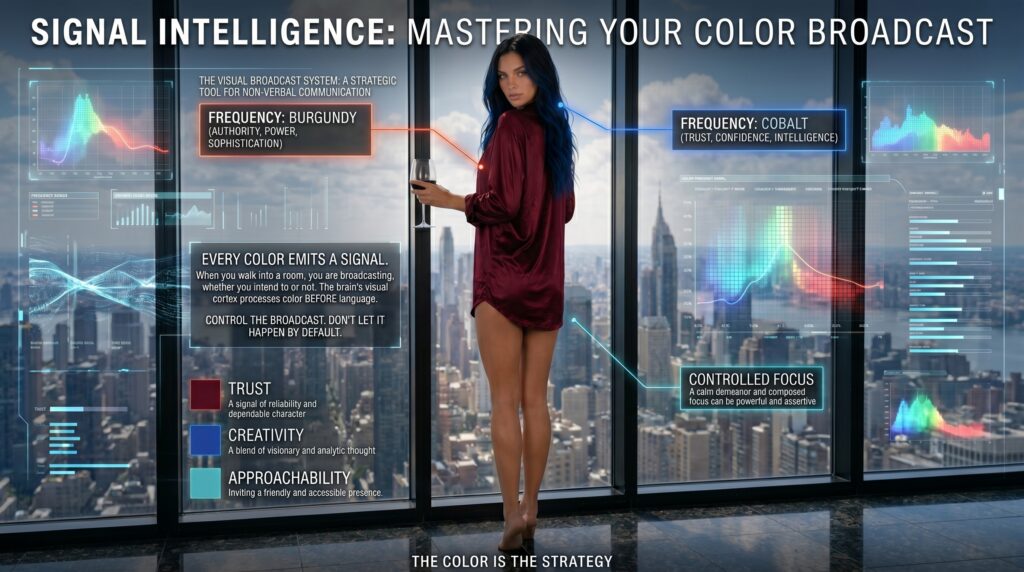
Every color emits a specific frequency or “signal”—Authority, Trust, Creativity, Approachability. When you walk into a room, you are broadcasting a signal, whether you intend to or not. The human brain’s visual cortex processes color before it processes language. The goal of signal intelligence is to control that broadcast deliberately, rather than letting it happen by default.
The Cost of Drifting
Guessing your way through AI tools is a fast way to lose time. Guessing your way through professional interactions is a fast way to lose leverage.
Think about the feeling of standing in your closet before a high-stakes meeting, feeling uncertain. That uncertainty doesn’t stay in the closet; it bleeds into your posture, your pitch, and your presence in the room. When you are forced to make a move under pressure, the worst thing you can do is take untested advice or drift into a decision by default.
You need a system. You need orientation. You need to dress with intention, just as you build digital infrastructure with intention. The people moving forward in this new era aren’t grinding more hours—they are using leverage differently. They are building systems that work with human psychology, not against it.
Introducing The Power Color Codex
To stop the guesswork, I built the infrastructure for your personal brand:
The Power Color Codex.
This is a 53-page, permanent decision framework built around situational intelligence: the colors you wear are a strategy. It doesn’t change with the seasons because human psychology doesn’t change with the seasons.
Inside, you’ll find 21 complete color profiles. This isn’t a basic color wheel; every spread gives you a full Signal Intelligence Dashboard that breaks down exactly what that color does when you walk into a room.
Here is what the framework provides:
- Command Presence Score: A measurement of the weight and authority of your visual signal.
- Deploy When: The exact, strategic moment to reach for a specific color.
- The Room Hears: What people perceive before you open your mouth.
- Color DNA: The signal it sends in one line.
Command the Room
AI can generate a perfect business plan, write flawless code, and analyze market trends in seconds. But it cannot walk into a room, look someone in the eye, and command trust. That is your job. That is the human advantage.
The Age of AI rewards people who can choose deliberately. It punishes those who drift.
“Some colors whisper. These ones close deals.”
Stop guessing. Start commanding.
Get the Power Color Codex on Etsy — $23
Want to understand the baseline signals before committing to the full framework? Start here.
References
[1] Singh, S. (2006). Impact of color on marketing. Management Decision, 44(6), 783–789.